Web design for guesthouses

Web design for guesthouses: Irish B&B sites built to win direct bookings

Booking.com and Airbnb find you guests, then take 15 to 18 percent of every booking. Your own website is what wins those same guests commission-free. When someone searches your guesthouse to book direct, a fast, credible site with solid local SEO is what turns that search into a booking you keep all of.

No obligation · same-day reply

What I build

What good guesthouse web design needs to deliver

Most B&B and guesthouse websites are outdated, slow to load, and hard to find for the searches that actually matter, the ones near your town and your local attractions. Guests research before they book, and the guesthouse with the fastest, most credible, best-ranked site wins the direct booking. Here is what I put in place for every guesthouse I work with.

Why it matters

Guesthouse web design starts with showing up on Google

Irish tourism runs on search. Guests planning a trip go straight to Google, and increasingly to your own site, before they ever ring to ask about a room or click book on an OTA listing.

When someone is planning a stay, the first thing they do is search for a place in your area and size up the options. The guesthouse that appears at the top of those results, with clear rooms, real local knowledge, and a site that loads fast on a phone, gets shortlisted. The ones that don't show up, or whose site looks like it hasn't been touched in years, quietly lose the booking to a listing on Booking.com that costs them commission they never had to pay.

Web design for guesthouses is not the same as a generic business website. A guesthouse site has to serve several distinct search intents at once: a guest searching "[town] B&B", someone after a "guesthouse near [attraction]", and a niche traveller looking for a "dog-friendly B&B" or a walking break. A site built around those distinct intents performs very differently to one recycled from a template library.

I build fast, clean guesthouse websites from scratch, never WordPress, never a template recycled from another industry. Everything is yours to own outright: no monthly platform fees, no lock-in, no developer needed for standard changes.

No obligation · same-day reply

Talk to me about your guesthouse

Tell me a little about your business and what your site needs to do. I'll come back with honest advice and a clear quote, no obligation.

Goes straight to my inbox. I read everything and reply usually within a few hours.

Web design for Irish guesthouses: what actually moves the needle

A guesthouse website has to do something most generic business sites never face: compete for the booking in a market where the OTAs already own the discovery. Booking.com, Airbnb and Expedia are where guests browse, and you can't and shouldn't try to out-list the platforms. What your own site can win, and what they can't take from you, is the direct booking: the same guest, booking with you straight, without 15 to 18 percent disappearing in commission.

The guesthouses winning direct bookings online are not always the biggest or longest-established. They are the ones with the fastest-loading sites, the clearest local positioning, and the right pages targeting the searches guests actually type. Web design for guesthouses, done properly, is as much about architecture, credibility and booking capture as it is about how the site looks.
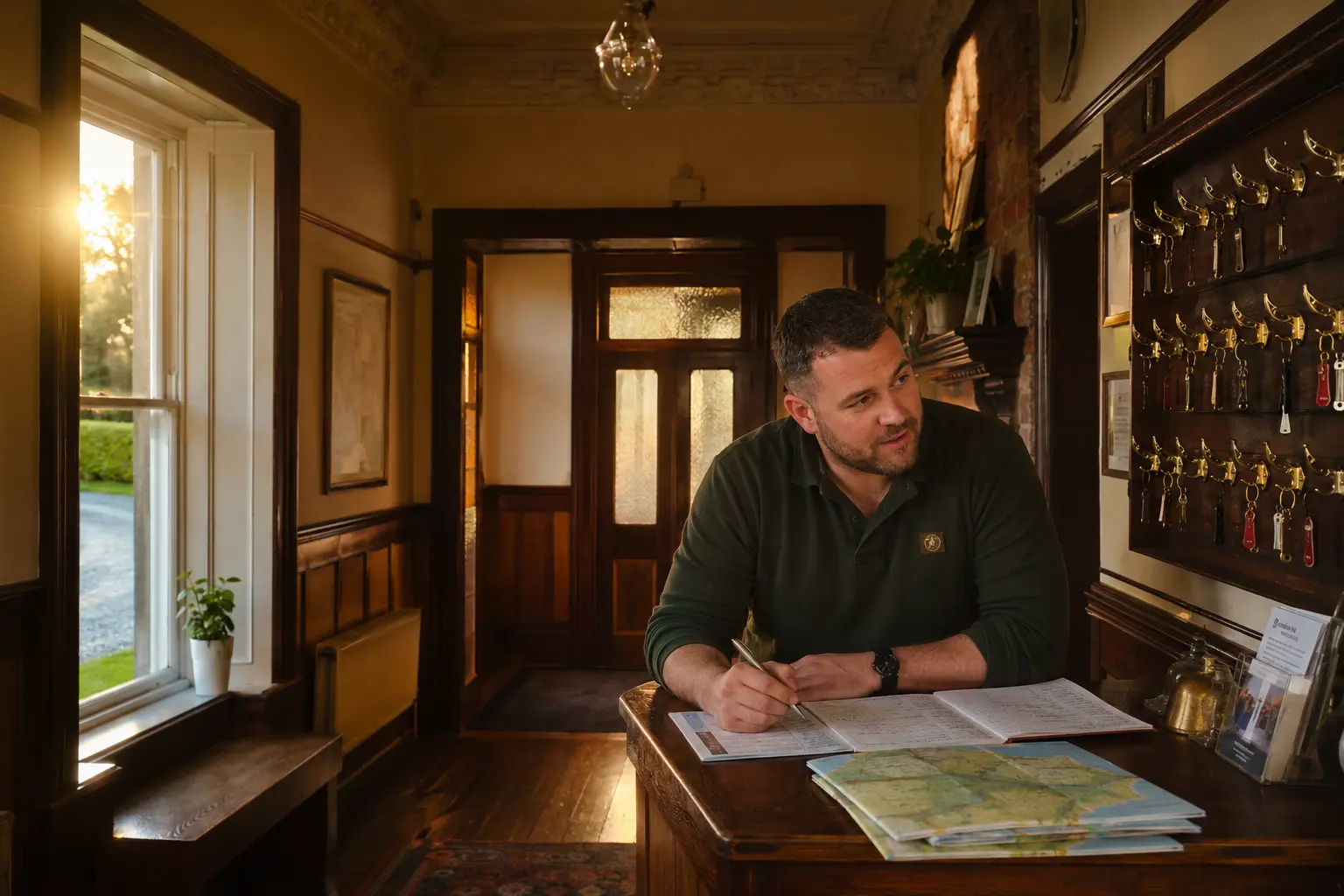
A guesthouse owner welcoming guests at a bright reception desk

Local SEO for guesthouse websites: how it works

Ranking locally for accommodation searches comes down to three interconnected things: a fast, well-structured website with pages targeting the right queries for your area; a Google Business Profile correctly set up and actively maintained; and a steady flow of genuine guest reviews. Those three signals largely determine who appears when someone nearby searches for a B&B or guesthouse to book.

The pages that matter most are not just the homepage. A dedicated page for each room type, each nearby attraction and each niche you serve gives Google more to rank and gives guests clearer answers. "B&B in Dingle" and "guesthouse near the Cliffs of Moher" are different searches that deserve different pages. I've written a plain guide to how local ranking works that covers exactly what factors move a guesthouse up the results.

Winning direct bookings instead of paying OTA commission

This is the part that pays for the site. Every booking through Booking.com, Airbnb or Expedia costs you 15 to 18 percent in commission, on a stay you'd have got anyway if the guest could book direct. The OTAs are excellent for discovery, they put you in front of travellers you'd never reach alone, but they should be the shop window, not the till. The booking should happen on your own site, at your own rate, with nothing skimmed off the top.

The pattern is consistent: a guest finds you on an OTA, then searches your name to book direct, often hoping to save. If your site is fast, credible and makes booking effortless, you keep the full rate and the guest relationship. If it's slow, dated, or has no direct booking option, they click back to the OTA and you pay the commission. Closing that gap, the credible site and the easy direct booking, is the single clearest win in guesthouse web design.

Web design for guesthouses near a key attraction or route

A huge share of accommodation searches are tied to a place or a route: "guesthouse near the Cliffs of Moher", "B&B on the Wild Atlantic Way", "accommodation near Killarney National Park". A guest searching those terms has chosen where they want to be and is ready to book. The guesthouse with a page written for that exact search, with real detail on distances, parking and what's nearby, wins the booking.

Most guesthouse sites mention the local area in a single line on the homepage and stop there. A dedicated page for each key attraction or route near you, with honest local knowledge a guest can't get from a generic OTA listing, ranks for those high-intent searches and builds the trust that turns a browse into a direct booking. This is where local positioning does the heavy lifting.

Booking, availability and enquiries on your guesthouse website

The right setup depends on how you run the place. A direct booking engine lets guests check availability and book a room straight from your site, at your rate, with no per-booking commission. If you already use a channel manager to keep the OTAs in sync, I can connect to that so availability stays accurate everywhere and you never double-book. Clear rooms and rates pages answer every question before the guest has to ask.

If you'd prefer something simpler, a clean enquiry form and a manual availability note, I can build that instead. The point is to match the site to how your guesthouse actually works, capturing the bookings that matter without adding admin. I'll advise on what fits your size and setup before anything is built, not after.

Guesthouse websites built from scratch, not templates

WordPress is slow, plugin-dependent, and a recurring security liability. The majority of guesthouse and B&B websites in Ireland run on it, often on the same handful of accommodation themes, which means they share the same performance floor and the same look. A site built from scratch in clean, modern code loads faster, scores higher on Google's Core Web Vitals, and stands apart from every other guesthouse on the same template.

Every site I build is yours to own outright: no monthly platform fee, no lock-in, no developer required for standard content changes like updating your rates, adding a room, or publishing a seasonal offer. The same model applies whether I'm building web design for a three-room B&B or a larger guesthouse with a direct booking engine. Fixed price, clear timeline, you own everything at the end.
The opportunity

The OTAs own discovery. Your site can own the direct booking.

Competition for local accommodation searches is thinner than you might think. A fast, properly structured site with the right room and attraction pages will outrank most existing guesthouses within months, not years, and win bookings the OTAs would have taxed.

Start the conversation
A guesthouse owner at their reception desk

Common questions

Web design for guesthouses: questions answered

Do I really need my own website when I am already on Booking.com and Airbnb?

Yes, and the two do different jobs. Booking.com, Airbnb and Expedia are where guests discover you, but every booking through them costs you 15 to 18 percent in commission. Your own site is where you win that same guest commission-free. Plenty of guests find you on an OTA, then search your name to book direct and save. A fast, credible site with clear rooms and a direct booking option turns that search into a booking you keep all of. The OTAs are for discovery; your website is for the direct booking.

Can you add a direct booking engine or availability calendar?

Yes. I can integrate a direct booking engine so guests check availability and book rooms straight from your site, with the rate you set and no per-booking commission. If you already use a channel manager to keep the OTAs in sync, I can connect to that so availability stays accurate everywhere. If you'd prefer to start simpler with an enquiry form and a manual availability note, that works too. I'll advise on what fits your size and setup before anything is built.

Will the site have proper rooms and rates pages?

Absolutely. Each room type gets its own clear page with photos, what's included, occupancy and rates, so guests know exactly what they are booking. Seasonal and midweek rates, minimum-stay rules and any packages can all be shown clearly. The aim is to answer every question a guest has before they book, so they book direct rather than clicking back to the OTA to compare.

We have a niche, dog-friendly, walking or golf breaks, weddings nearby. Can the site target that?

Those are exactly the searches worth owning, and they deserve their own pages. A dedicated page for dog-friendly B&B, walking or golf breaks, or accommodation near a wedding venue ranks for those specific terms and speaks directly to that guest. Someone searching "dog-friendly B&B in Kenmare" is far closer to booking than someone browsing generally, and a page written for them wins the booking the OTAs never surface.

What will a guesthouse website cost?

It depends on what the site needs to do: the number of rooms and pages, whether you want a direct booking engine and channel manager integration, and how much content there is to build. Every project starts with a free consultation and ends with a fixed quote, not an hourly rate. You know the full cost before I start, and it doesn't change.

How long does a guesthouse website take to build?

A standard B&B or guesthouse site, homepage, rooms, rates, things to do nearby and a booking or enquiry page, takes around three to four weeks from brief to live. A larger site with a direct booking engine, channel manager integration and several niche landing pages, allow five to six weeks. You'll get a fixed price and a clear timeline before any work starts.

I am Fáilte Ireland approved. Can the site reflect that?

Yes, and it should. Fáilte Ireland registration and approval are trust signals guests look for, so they belong front and centre, alongside your star rating, reviews and any quality marks. I'll make sure your approval, awards and genuine guest reviews are clear on the pages that matter, so a guest deciding between you and a listing on an OTA sees every reason to book direct with confidence.

Guesthouse web design that fills rooms without the commission

Fast, built from scratch, ranked for the searches that bring guests straight to you. Commission-free direct bookings, fixed price, you own everything, no monthly lock-in.

Call Dave — 083 140 6725
Call Dave